
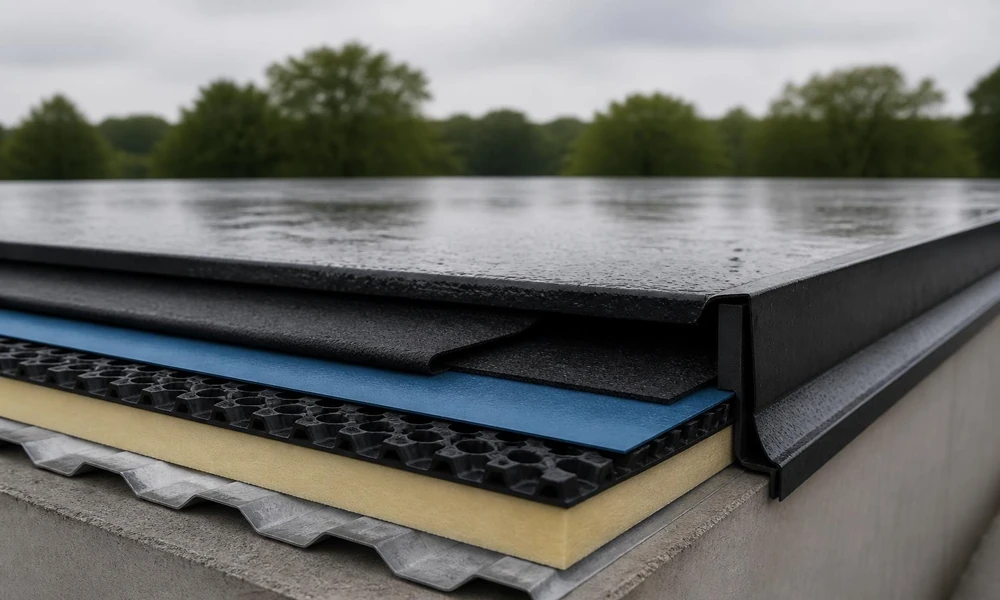
For decades, residential roofing decisions were largely driven by familiar materials, basic code compliance, and the expectation that the outer roof covering would handle most weather exposure. Asphalt shingles, felt underlayment, plywood or oriented strand board decking, and standard fastening patterns formed a system that worked reasonably well under ordinary conditions. Severe wind events, however, repeatedly exposed weaknesses that were not always obvious during normal service.
Modern roofing takes a more layered approach. Instead of treating shingles or panels as the roof’s primary defense, newer standards increasingly consider how the covering, fasteners, deck, underlayment, edges, flashing, and water barriers perform together. Research into wind uplift and wind-driven rain has also influenced building codes and installation practices, particularly in regions exposed to hurricanes and strong thunderstorms.
What Did Older Roofing Standards Expect From the Roof?
Roof covering: Traditionally, shingles, tiles, or metal panels received most of the attention because they formed the visible weather surface. If the covering appeared intact, the roof was often considered adequately protected. Modern testing has shown that losing even part of the covering can start a sequence that exposes underlayment and decking to wind and water.
Smooth-shank fastening: Older roof assemblies frequently relied on conventional smooth nails and fastening schedules that were acceptable under previous codes. Today’s high-wind construction may call for stronger attachment patterns and fasteners with greater withdrawal resistance. The Insurance Institute for Business & Home Safety describes its FORTIFIED approach as using ring-shank nails, tighter deck-nailing patterns, sealed roof decks, and reinforced roof-edge details to improve resilience.
Felt underlayment: Asphalt-saturated felt was long the standard secondary layer beneath shingles. It remains useful and is still permitted in many assemblies, but modern roofing offers additional underlayment options and more demanding installation requirements in certain conditions.
Minimum protection: Earlier codes often focused primarily on preventing structural failure under prescribed conditions. Newer standards increasingly address what happens after part of the roof covering is damaged. That distinction is important because a building can remain structurally standing while water entering through the roof causes significant interior damage.
Property owners comparing repair, replacement, restoration, gutter, siding, or storm-damage work can also use a contractor such as HK Construction to evaluate how the visible roof relates to the rest of the exterior system. Its services include roof repair and replacement, commercial roofing, gutters, siding, restoration, painting, decks, fences, and assistance with insurance claims. Looking at those components together can be particularly useful after wind or hail damage, when the condition of roof edges, drainage components, siding, and related exterior surfaces may influence the appropriate scope of work.
How Has Wind Resistance Become More Precise?
Wind rating: A shingle’s wind rating is no longer simply interpreted as a promise that the roof will survive a storm of the same advertised speed. Roofing products are evaluated using standardized test procedures that examine specific modes of failure.
For example, IBHS notes that ASTM D3161 exposes shingles to fan-generated wind for a prescribed period, while ASTM D7158 evaluates both aerodynamic uplift forces and the strength of the shingle seal. These classifications help determine whether a particular product is appropriate for specific wind conditions.
Uplift resistance: Wind does not push uniformly downward on a roof. Pressure differences can create suction that attempts to lift roofing materials away from the structure. Roof corners and edges can experience particularly demanding forces, which is one reason modern design pays greater attention to fastening and perimeter details.
Roof-edge protection: Older installations sometimes treated drip edge and starter shingles as relatively minor finishing components. Current resilience research gives them greater importance because wind often begins damaging a roof at its perimeter. Better attachment at the eaves and rakes can make it harder for wind to get beneath the covering and progressively peel material away.
Shingle sealing: Asphalt shingles commonly contain factory-applied adhesive intended to bond neighboring courses together. The effectiveness of that seal depends partly on installation conditions and temperature. IBHS notes that shingles may require considerably longer to seal during cooler conditions, leaving a newly installed roof more vulnerable before adhesion develops fully.
Why Is the Roof Deck Now Part of Water Protection?
Sealed roof deck: One of the most important shifts is the idea that roof decking should remain protected even after the primary covering is damaged.
Historically, losing shingles could quickly expose underlayment and deck seams. Once water passed through those layers, insulation, ceilings, wall cavities, flooring, and personal property could be affected.
A sealed deck creates another line of defense. IBHS-backed code developments have expanded sealed-roof-deck provisions in high-wind areas, reflecting greater recognition that reducing water intrusion can be nearly as important as keeping the roof covering attached.
Deck attachment: The connection between structural panels and roof framing has also received more scrutiny. Ring-shank nails provide greater resistance to withdrawal than comparable smooth-shank nails because their ridged shanks grip the wood more aggressively. Modern resilient-roof specifications may combine those fasteners with closer spacing in vulnerable areas.
The old approach asked whether the deck was attached. The newer approach asks how strongly it is attached, what loads it must resist, and what happens if the exterior covering above it fails.
What Changed Beneath the Shingles?
Underlayment: Modern underlayment is not simply a temporary covering placed between decking and shingles. It is increasingly treated as part of the roof’s water-management system.
The National Roofing Contractors Association notes that recent building-code provisions include enhanced underlayment materials and installation methods for circumstances such as low-slope roofs and high-wind regions.
Synthetic materials: Traditional felt remains available, but synthetic underlayments have become common because they can offer favorable tear resistance, lighter weight, and easier handling. Performance still depends on product specifications, fastening, overlaps, exposure limits, and compatibility with the roof covering.
Water-barrier strategy: Modern design increasingly distinguishes between shedding ordinary rain and resisting water intrusion after storm damage. That is why taped deck seams, self-adhered membranes, properly installed underlayment, and sealed-deck methods have gained attention.
Does Newer Automatically Mean Better?
System compatibility: Not necessarily. A high-rated shingle installed incorrectly can perform worse than a more ordinary product installed according to its tested assembly. The deck thickness, nail type, fastening location, starter course, underlayment, flashing, ventilation, and edge details all influence performance.
Local requirements: Roofing standards are not identical nationwide. Climate, design wind speed, building type, roof geometry, local code adoption, and manufacturer requirements can change what is appropriate.
Existing construction: Older homes may contain decking, flashing, ventilation arrangements, or structural details that do not match current construction methods. A roof replacement can therefore involve more than removing old shingles and installing new ones.
What Does the Shift Mean for Roof Owners Today?
The biggest change is not a single new roofing material. It is the transition from viewing a roof as one weatherproof surface to viewing it as an interconnected assembly.
Older practice concentrated heavily on keeping the outer covering in place. Current standards place more emphasis on tested wind performance, stronger deck connections, secure edges, enhanced underlayment, secondary water protection, and installation details that account for predictable failure points.
That approach does not make modern roofs invulnerable. Materials still age, sealants weaken, fasteners can be installed incorrectly, and severe storms can exceed design expectations. IBHS research notes that asphalt-shingle sealant strength can decline substantially as roofs age, demonstrating why the condition of an existing roof matters alongside its original rating.
The practical difference is that today’s roofing standards increasingly ask what happens when the first layer begins to fail. By strengthening the layers underneath and the connections between them, modern systems are designed to reduce the chance that localized roof damage becomes widespread structural or interior damage.

Comments are closed.